 The online submission date is past due and after the submitted AI's duked it out and a winner has been declared, but the fun isnt over for those of you that missed the chance! Here is the page with all the starter kits in many various languages that will allow you to program an AI to play this game!
Wednesday, December 15, 2010
Google AI Challenge
The online submission date is past due and after the submitted AI's duked it out and a winner has been declared, but the fun isnt over for those of you that missed the chance! Here is the page with all the starter kits in many various languages that will allow you to program an AI to play this game!

Tuesday, December 14, 2010
Alife Game: bSerene
bSerene

While you may need an old operating system to play it,its still cool to see an evolutionary algorithm put into game AI. This site hosts download for an Alife game that offers its source code called bSerene is a game where monsters learn to play against the player via Artificial Life. The behavior of the monsters is governed by about 50 parameters, which are used as genes in a genetic algorithm. At the end of every arena the monsters that have inflicted the most damage on the players are saved to file and used as the parents of monsters in subsequent games. Monsters who are close to another monster that manages to hit you get a percentage of the credit.
Without having to look at the source code: You can change the appearance of the program by putting in your own pictures for the explosions power-ups and projectiles, or you can design your own arenas by simply modifying some txt-files in the game folder. The source code and executable game is provided for download here.

While you may need an old operating system to play it,its still cool to see an evolutionary algorithm put into game AI. This site hosts download for an Alife game that offers its source code called bSerene is a game where monsters learn to play against the player via Artificial Life. The behavior of the monsters is governed by about 50 parameters, which are used as genes in a genetic algorithm. At the end of every arena the monsters that have inflicted the most damage on the players are saved to file and used as the parents of monsters in subsequent games. Monsters who are close to another monster that manages to hit you get a percentage of the credit.
Without having to look at the source code: You can change the appearance of the program by putting in your own pictures for the explosions power-ups and projectiles, or you can design your own arenas by simply modifying some txt-files in the game folder. The source code and executable game is provided for download here.
Tuesday, November 2, 2010
LED Text Scroller using an Arduino Mega
The following project description is an entry in the Visual Representation of Learn Experience Innovate of the Academic Palloza, Fall 2010 competition held at the University of Advancing Technology.
The overall process in design is actually fairly simple. The circuit design shown in Figure 1 below shows the simple circuit used for each LED to be lit.

Figure 1. Schematic.
Figure 1 is easy to understand. Signal goes from a Digital I/O pin, through an LED, a 150 ohm resistor, and to ground. It can be repeated for as many pins as the user wants. The software is set up to run a 5 X 9 grid of LEDs. The software uses a 5 X 15 array that represents all of the LEDs plus the extra on the right, and the text scrolls to the left.
Below are several photos from the testing phases of the design and implementation of software. Below that is the source code, written for an Arduino Mega.
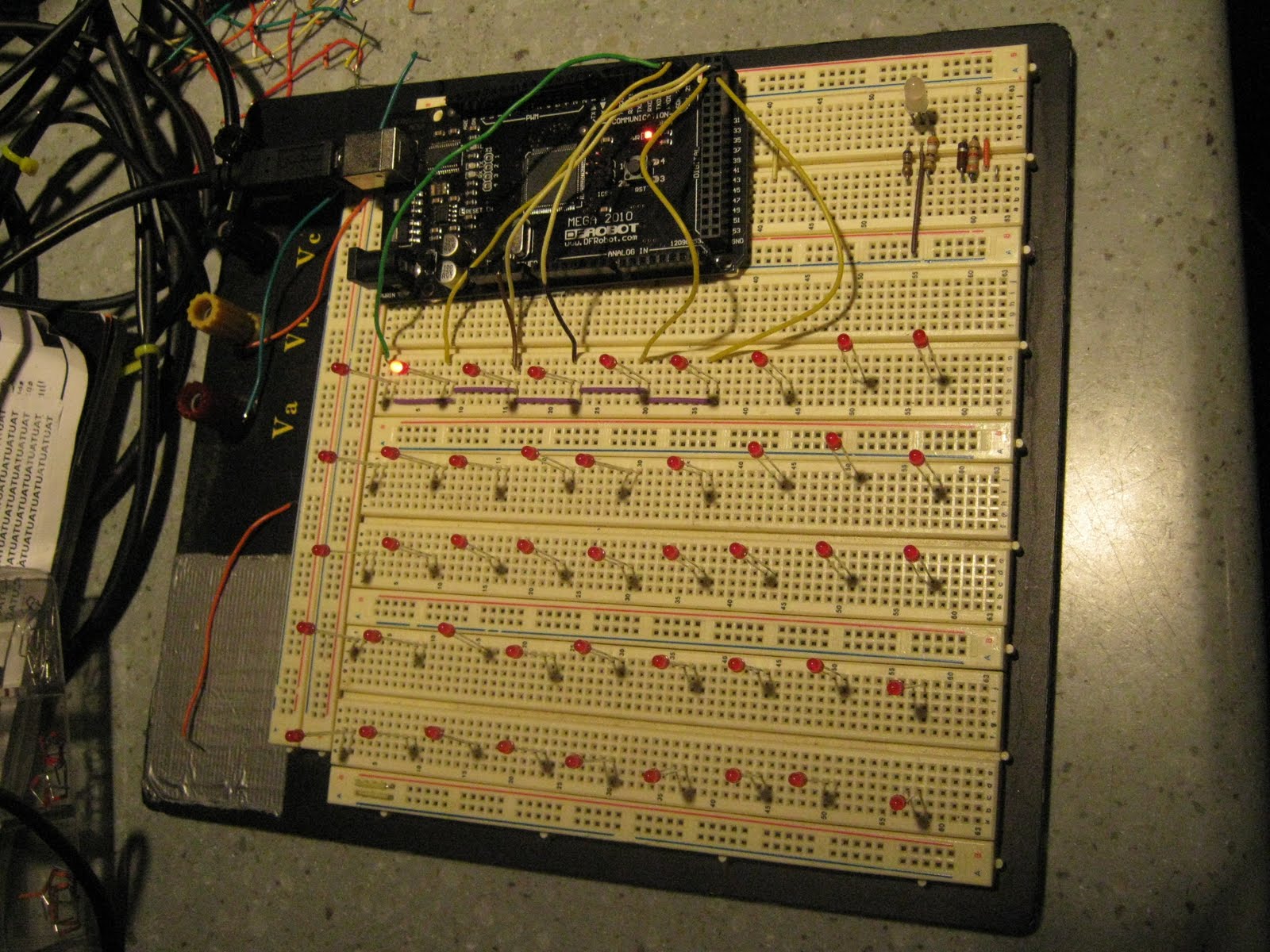
Early testing phase of the design and wiring.

Testing of everything wired.
The video above shows an early version, before the resistors were added to the LEDs (A VERY BAD CHOICE TO DO) and before the serial communication was working.
The source code can be found here.
Expect to work about 5 hours to get all of the wiring working, and the source code implemented and debugged for your setup.
Friday, October 22, 2010
Nameless Microwave gets Down N' Dirty[Video]
Things are moving fast for the RoboWargames team. In and out of UAT. The team (headquarters located in the 244 hardware lab) took their stock Parallax rover out for a spin yesterday after refueling it with both hydraulic fluid and gasoline. After a short warm up and a few minor hiccups the rover was soon getting carried away with itself. Under the control of a remote ofcourse. The max speed of the rover is ~15 mph but due to the hydraulic settings it was cruising at a good ~10 mph.
The rover will eventually be pimped out with a laser range finder, onboard cameras, various sensors, a sleek casing, and autonomous programming. It will be our entry into the IGVC (Intelligent Ground Vehicle Competition) in the summer of 2011.
Sunday, September 19, 2010
Visual 6502 Processor Simulation
Greg James, Barry Silverman and Brian Silverman from Visual6502.org have been working for the last year on a transistor-level visual simulation of the 6502 microprocessor. Their work is incredibly detailed and very interesting. The 6502 design is a classic processor, and very important in computer history as it was used in the Apple I & II, Commodore, Atari and Nintendo computing systems.
In the summer of 2009, working from a single 6502, we exposed the silicon die, photographed its surface at high resolution and also photographed its substrate. Using these two highly detailed aligned photographs, we created vector polygon models of each of the chip's physical components - about 20,000 of them in total for the 6502. These components form circuits in a few simple ways according to how they contact each other, so by intersecting our polygons, we were able to create a complete digital model and transistor-level simulation of the chip.
Wednesday, August 4, 2010
Prizes for Electric Car Algorithms
The CREATE Lab at Carnegie Mellon University is sponsoring a contest to develop efficient battery-management algorithms for electric vehicles. At the end of every month, high-performing entries will be awarded small prizes ($100 in Amazon gift cards), with a grand prize (possibly an actual electric vehicle) awarded at the end of the competition. At the end of each monthly judging phase, entries are open-sourced for all to see and share.
Sunday, July 11, 2010
Autonomous Battery Exhange
Researchers at Ecole Polytechnic in Lausanne have developed marXbot and snazzy battery exchange system. The batteries are modular and charge in a kind of ferris-wheel. When the robot runs low on juice, it docks with the station, and the dead battery is removed from the robot chassis by a manipulator. During the swap, robot power is provided by an alternate ultra-capacitor based system that can provide 15 seconds of power for the critical systems (i.e. only maintaining cpu memory state). The wheel rotates to a fresh battery, and the manipulator pushes it into the chassis, completing the hot-swap.
Tuesday, June 29, 2010
Graffiti Analysis Sculptures
Graffiti Analysis: 3D from Evan Roth on Vimeo.
Graffiti Analysis: Sculptures is a series of new physical sculptures that I am making from motion tracked graffiti data. New software (GA 3D) imports .gml files (Graffiti Markup Language) captured using Graffiti Analysis, creates 3D geometry based on the data and then exports a 3D representation of the tag as a .stl file (a common file format compatible with most 3D software packages including Blender, Maya and 3DS Max). Time is extruded in the Z dimension and pen speed is represented by the thickness of the model at any given point. I then have this data 3D printed to create a physical sculpture that serves as a data visualization of the tag. For the Street and Studio exhibition at the Kunsthalle Wein, I collaborated with an anonymous local Viennese graffiti writer and had the GA sculpture printed in ABS plastic. Graffiti motion data of his tag was captured in the streets (for the first time) at various points around Vienna.
More information (including software, source code, and many more pictures) can be found at Evan's website.
Self-Folding Origami
Robert Wood of Harvard University, Daniela Rus and Erik Demaine at the Massachusetts Institute of Technology take us to a new level of robotic creepiness with self-folding origami. The device is able to morph itself into new shapes using shape-memory alloys that line the edges of triangular modules. Each module also sports a strong magnet that holds the final form after a module has executed a desired fold.
Wednesday, June 9, 2010
3D Printed UAT Shadow Sculpture

Last week I built this shadow sculpture inspired by the cover of the Pulitzer-prize winning book "Gödel, Escher, Bach: An Eternal Golden Braid" this is a 3D-printed form that casts three orthogonal shadows in the shapes of the letters UAT. After I printed it, I used some blue LEDs and foam-core to build a little display platform for it.

Here is the Inventor part file: UATCube.ipt
Subscribe to:
Posts (Atom)