
Showing posts with label circuits. Show all posts

Friday, March 9, 2012

Torrent of Tesla Coil Tutorials

Photo by Flickr user Pekar [source]
Tesla Coils are a special type of transformer originally intended to broadcast electrical power without the use of wires.  These days they're primarily used for special effects in TV and movies, electrical testing (why wait for lightning to strike? Make your own!) and plain old mad-scientist style geeky fun.

Instructables has a couple of excellent tutorials on building the Basic Spark Gap Tesla Coil, and a more advanced Solid State Tesla Coil that can be modulated to play music.

Get Cracking Roboteers!

Friday, September 2, 2011

Automatic Cat Feeder

It's 4am, and I'm sound asleep dreaming of robots when I'm startled awake by 10 lbs of hungry cat jumping on my face with a pleading "mew".  I get up, feed the cats, and unsuccessfully attempt to resume my slumber.  This scene repeated itself every day for only a couple weeks before I decided I needed an automatic cat feeder to maintain my sanity.

The feeder needed to only handle dry food, be able to ration food quantity so that the cats wouldn't get fat, and it needed to have a lot of storage so that the cats wouldn't starve while my wife and I were traveling.  Similar off-the-shelf feeders cost upwards of $50, and I like a challenge, so I set out to build one myself.

Build details and more pictures after the break.

Sunday, September 19, 2010

Visual 6502 Processor Simulation

Greg James, Barry Silverman and Brian Silverman from Visual6502.org have been working for the last year on a transistor-level visual simulation of the 6502 microprocessor.  Their work is incredibly detailed and very interesting.  The 6502 design is a classic processor, and very important in computer history as it was used in the Apple I & II, Commodore, Atari and Nintendo computing systems.

In the summer of 2009, working from a single 6502, we exposed the silicon die, photographed its surface at high resolution and also photographed its substrate.  Using these two highly detailed aligned photographs, we created vector polygon models of each of the chip's physical components - about 20,000 of them in total for the 6502.  These components form circuits in a few simple ways according to how they contact each other, so by intersecting our polygons, we were able to create a complete digital model and transistor-level simulation of the chip.
Tuesday, June 29, 2010

Self-Folding Origami


Robert Wood of Harvard University, Daniela Rus and Erik Demaine at the Massachusetts Institute of Technology take us to a new level of robotic creepiness with self-folding origami.  The device is able to morph itself into new shapes using shape-memory alloys that line the edges of triangular modules.  Each module also sports a strong magnet that holds the final form after a module has executed a desired fold.

Wednesday, May 26, 2010

ArcAttack: Ride the Lightning

I've always been fascinated by Tesla Coils. The operating principle is so elegant - you set up one circuit (your power supply) that oscillates at some high frequency, and you set up another circuit that uses the earth to resonate with your power circuit. Energy is transferred and converted from current to voltage, and the end result is man-made lightning - an incredible display of light and sound.

Newer versions of the Tesla coil allow the control of the resonant frequency.  Have you ever noticed the sound that a flourescent light makes?  That kind of "buzz" ? You're hearing the frequency of the power that is coming into your house (around 60Hz).  When you control the resonant frequency of the Tesla, you control the tone that it generates, and thus the Singing Tesla Coil is born.  This is not lightning set to music - the sound is generated by the spark itself.

The band ArcAttack has integrated a pair of singing Tesla coils into their repertoire, with epic results:


Saturday, April 3, 2010

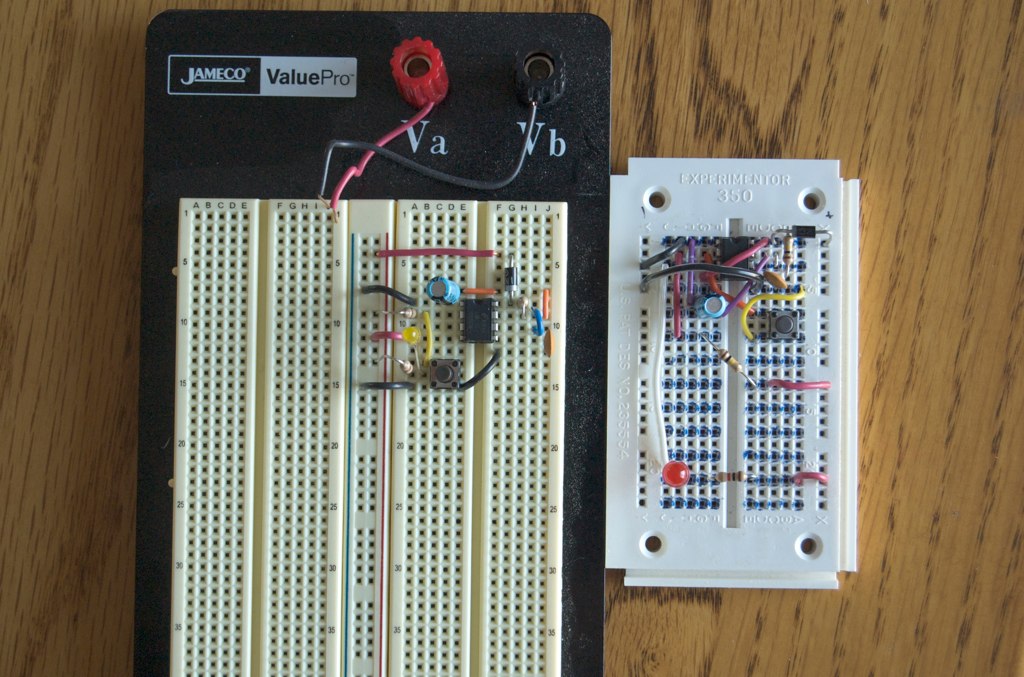
Practice Makes Perfecgt

From Flickr user mrbbking:
Two copies of the same circuit. The one on the right was done first, and is a pretty good rat's nest, if I do say so myself. The one on the left was built based on the other one, but with an eye toward clarity. Much easier to see what's going on! I guess that figuring out the layout based on a schematic is a skill that needs practice.

Monday, March 1, 2010

Sell your designs through BatchPCB!

BatchPCB is starting a new service where circuit designers can sell their boards through the BatchPCB Marketplace.

NEW FEATURE FOR BATCH PCB!
Mar 1, 2010

So you made a PCB design? Think others might benefit from it? Sell it! You can sell as many (or as few) designs as you want and can receive payment via check or paypal.