This is the blog for the Robotics and Embedded Systems program at the University of Advancing Technology in Tempe, AZ. Find out more about our program at majors.uat.edu/robotics/
Things are moving fast for the RoboWargames team. In and out of UAT. The team (headquarters located in the 244 hardware lab) took their stock Parallax rover out for a spin yesterday after refueling it with both hydraulic fluid and gasoline. After a short warm up and a few minor hiccups the rover was soon getting carried away with itself. Under the control of a remote ofcourse. The max speed of the rover is ~15 mph but due to the hydraulic settings it was cruising at a good ~10 mph.
The rover will eventually be pimped out with a laser range finder, onboard cameras, various sensors, a sleek casing, and autonomous programming. It will be our entry into the IGVC (Intelligent Ground Vehicle Competition) in the summer of 2011.
Researchers at Ecole Polytechnic in Lausanne have developed marXbot and snazzy battery exchange system. The batteries are modular and charge in a kind of ferris-wheel. When the robot runs low on juice, it docks with the station, and the dead battery is removed from the robot chassis by a manipulator. During the swap, robot power is provided by an alternate ultra-capacitor based system that can provide 15 seconds of power for the critical systems (i.e. only maintaining cpu memory state). The wheel rotates to a fresh battery, and the manipulator pushes it into the chassis, completing the hot-swap.
Robert Wood of Harvard University, Daniela Rus and Erik Demaine at the Massachusetts Institute of Technology take us to a new level of robotic creepiness with self-folding origami. The device is able to morph itself into new shapes using shape-memory alloys that line the edges of triangular modules. Each module also sports a strong magnet that holds the final form after a module has executed a desired fold.
This is a project I've wanted to build for years - my own concept was to construct a system powerful enough to paint a graphic on the side of a dorm at my Alma Mater from across campus.
This is a motor test of the UAT Educational Robot Platform, developed as a class project by Dan Willinger and Stephen Harper. The robot will be used as a learning platform for advanced sensor interfacing and mobile autonomous system development at the University of Advancing Technology. This is one of the two robots that Dan and Stephen built, each costing about $1200.
A final project demonstration by Ryan Carmain, Kayla Bayens, and Leonard Hockett of their Accelerometer controlled robot. This project was for my course RBT173 - Introduction to Microcontrollers. The controller uses an accelerometer to sense the direction of gravity, which is sent over a serial connection to the robot, and translated into motor commands.
This is Andre Walker's final project for my course RBT173 - Introduction to Microcontrollers. The project is a text-to-speech robot that mimics emotions and reads specially tagged twitter messages out loud. It is a modified version of the GanzBot project.
CHARLI is actually a series of robots that initially consists of the 5-foot tall CHARLI-L (or lightweight, pictured above), and the forthcoming CHARLI-H (or heavy), both of which are completely autonomous, with a full range of movements and gestures thanks to a series of pulleys, springs, carbon fiber rods, and actuators (not to mention some slightly more mysterious AI). What's more, while CHARLI-L is currently restricted to walking on flat surfaces, CHARLI-H promises to be able to walk on the uneven ground around the Virginia Tech campus, and eventually even be able to "run, jump, kick, open doors, pick up objects, and do just about anything a real person can do."
This robot reminds me a lot of the machines from I, Robot. I can't wait until machines like these are ninja-ing around the world.
Have you ever wanted to meet a Mythbuster in real life? Have you ever wanted to see behind the scenes of a ComBots event, and see how some of the world’s most badass robots are built? Now’s your chance to do both of those things at once! Enter the RoboGames 2010 Bots Behaving Badly Contest! Take a video, take a picture, or make a photoshop of a robot behaving badly, and submit it to YouTube, or Flickr. Get everyone you can to check it out, because the submission with the most views wins!!
How To Enter:
- Take a video or a picture, or make a photoshop of a robot behaving badly
- Upload it to YouTube or Flickr, with the tag “BadBots2010″ (IF YOU DON’T, YOU WONT BE ENTERED)
- Every submission MUST link prominently to RoboGames.net, and somehow be related to Bots Behaving Badly (this is at the judges’ discretion)
- Share your entry- send it to friends, post it on digg etc etc etc
- The entry with the most views wins!
Prizes:
1st Place: 2 tickets to RoboGames 2010, 2 passes to the RoboGames Builder’s Party on Friday, April 23, a RoboGames Goodie Bag, and access to the pit at RoboGames (where contestants build their robots) with a meet-and-greet with Mythbusters’ Grant Imahara
2nd Place: 2 tickets to RoboGames 2010, 2 passes to the RoboGames Builder’s Party on Friday, April 23, 2 RoboGames T-Shirts, and 2 packs of RoboGames Trading Cards
3rd Place: 2 tickets to RoboGames 2010, a RoboGames T-Shirt and a pack of RoboGames Trading Cards
Judges Award: 1 ticket to RoboGames and a RoboGames T-Shirt
Deadline: 4/22/2010 at 11:59pm
Can’t make it to RoboGames? No problem! Alternatives to tickets will be also available to winners!
All rules subject to change without notice
The Fine Print:
· Participants agree to abide by all rules and decisions set by RoboGames.
· RoboGames reserves the right to reject an entry for any reason.
· Should a winner be unable to attend RoboGames 2010, RoboGames will determine an appropriate substitute of approximately equal value.
· RoboGames reserves the right to modify or cancel the contest at any time, at its sole discretion.
· By submitting your entry and entering this contest, you grant RoboGames royalty-free rights to publish, reproduce, or otherwise distribute your work commercially or by any other means.
· Governing Law: All issues and questions concerning the construction, validity, interpretation and enforceability of the official rules, or the rights of entrants, shall be governed by and construed in accordance with, the substance laws of the State of California and any applicable laws and regulations of the United States.
· You must be over the age of 18.
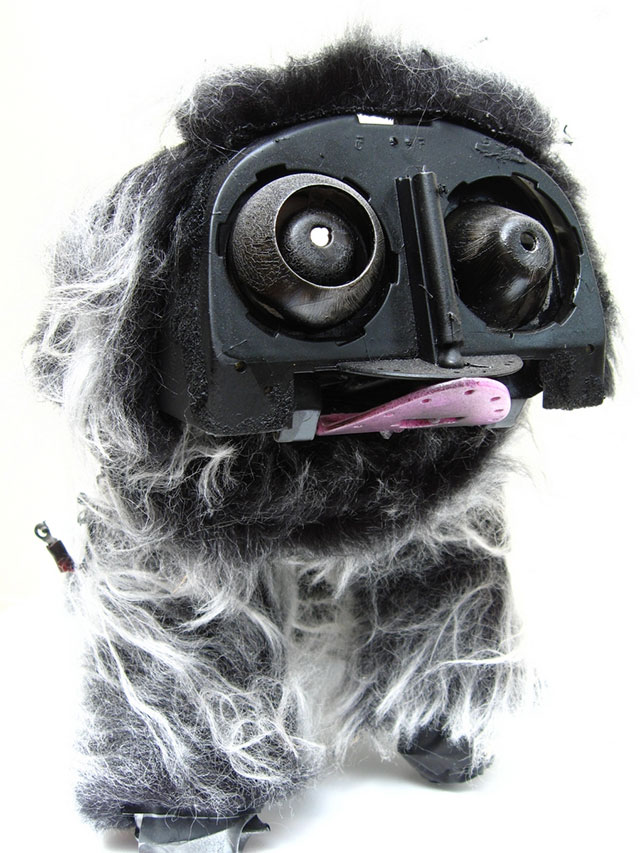
This is the kind of thing that I'd like to see students produce in the Physical Computing Studio (RBT307) course next semester. Quick, dirty robots held together by hot glue and electrical tape. The idea is that once we strip away the requirement of long-term durability, we can move quickly through design iterations, and learn a great deal about functional, physical design and manufacturing methods.
When I was growing up, I was destined to be an engineer. I would go to the library and check out every book I could on robots - big picture books of robots, children's books on robots, even some academic books that I couldn't really understand as a child, but the diagrams and illustrations captivated me. I was enchanted by the idea of building my own machine.
Make has a short article on one of my favorites, and I'm now destined to spend the rest of my evening perusing the Old Robots website.